Friday, February 22, 2008

Little Muffins in the Big City

Greetings from Philadelphia everyone! So today was our first full day here and we went to City Hall and the museum to see the Frida Kahlo exhibit and other awesome collections. We've also had a lot of opportunities to walk around the city and check out all the different sights. One of the things that I've found most interesting is all the art that is in this city. also, we weren't allowed to take pictures in the gallery so here's what you wouldve seen...


Today we got to see the big clothespin by Claes Oldenberg and the LOVE sculpture by Robert Indiana. Also, Philly has the largest urban mural program in the country...we also discussed the murals that Diego Rivera (Frida's husband) created, including the very controversial mural that was destroyed in the Rockefeller building.

So this got me thinking...If you all had the opportunity to create a mural on any building on Denison's campus, which building would you choose and what images would you paint...and why? Consider the contributions of the community and that impact that it'll make.

Here are some photographs to inspire you...


Thursday, February 21, 2008

Kehinde Wiley

Kehinde Wiley was born in LA in 1977 and has since moved to New York to work. He got his BFA from the San Francisco Art Institute and his MFA from Yale. His paintings have been sold from anywhere between $12,000 – 40,000 and has hundreds of people waiting in line to buy new paintings of his, clearly showing how popular his work is.

His paintings have been dubbed a combination of “European portraiture meets hip-hop culture.” He finds young, black males in urban environments (usually Harlem) and has them pose in positions of their choosing from a number of famous Western paintings. These paintings come from portraits done between the 16th – 19th centuries, painted by the likes of Titian, Ingres, Reynolds, Tiepolo and others.

He paints the men in the same poses as the people in the classical pieces, but wearing the same outfits he finds them in; often times wearing baseball hats, athletic jerseys, and oversized jeans. His paintings are done in hyper-realism, with thick paint and lush lighting, and the works include styles from the Renaissance painters, French rococo painters, as well as urban graffiti artists. He also creates unique, psychedelic, and ornate backgrounds for all of his pieces.

Seeing as how the historical paintings on which he bases his paintings were all done of rich aristocrats or glorified generals or the like, the Africa-American men in his paintings are usually seen as powerful, heroic, grand, wealthy, and inspiring. These qualities also come about because of the sheer size of the paintings, some over 9 feet tall.

Some questions come to my mind when looking at his work that I will pose to all of you. These include, but aren’t limited to:

How do you feel about the backgrounds of each piece? What do they add to the paintings, if anything? Do the natural themes of the men collide in a good way or bad way with the artificial shapes in the background?

Do you think the statement “European portraiture meets hip-hop culture” is accurate when describing his work?

What do you think Wiley is trying to say about class, wealth, oppression, power and race in his work? Could he be saying these men will never actually achieve this power in society, and thus the dream can only be captured in a painting, or could he possibly be trying to get these men to strive to reach this goal?

Would you consider his detailed portraits of Africa-Americans in positions of power (which may also invoke a sense of envy) to be unique and original? If so, is this why they are so popular? Is it possible that even he not know what these pieces are trying to say, but may just have created them to put a contemporary viewpoint on famous historical paintings?

Aside from the different themes and subjects, do you think his style of painting and painting technique mimics those of the great portrait painters of the 16th, 17th, 18th, and 19th centuries? If not, how are they different?

Feel free to answer any or all of these.


Tuesday, February 19, 2008

Painting Figuratively with Yuskavage


Yuskavage was born in Philadelphia in 1962. She received her MFA from Yale University, and is currently living and working in New York City. She made her name in the 1990’s, and now she is a very big name in the art world. Her exhibition in a New York gallery last year sold out before the opening, and one painting sold for over $1 million.

Lisa Yuskavage’s work is described as exploring “confrontational sexuality” of female nudes. She has been likened to painters in art history such as Tintoretto, Michelangelo, Goya, and Rothko in terms of process and appeal, but her work is also described as kitsch (Playboy models and pornography). I find her work quite interesting in questioning the position of the female nude, overt sexuality in art, and what her appeal is to so many people.

With process, Yuskavage makes models of her figures before painting them, to study poses and light. A lot of her work can be connected to poses and methods of painting the female nude in art history, such as “Balls” and “Dutch Girl.” “Dutch Girl” makes me think of the females portrayed by Dutch painters such as Vermeer.

Much of Yuskavage’s work is about the response from the viewer. “When Lisa looks at the female nude, in her whole body of work, she is pushing notions of viewership, voyeurism, and our responses to very confrontational psychologically charged images and erotic images.” What is the line between good art and pure pornography? Is the intent to arouse the viewer? Or is Yuskavage pointing to something deeper? Her work has been described as feminist, with a critic saying “You can’t paint the female nude and use it in an explicit and confrontational way and not have it seen as feminist.”

I find the “Ledge” paintings interesting. They are said explore symbiotic psychological relationships. Indeed, the paintings with two female figures in them make me think of the women’s relationships to one another. At first glance, it seems sexual, but perhaps it is about the struggles a woman faces between her sexuality and her femininity.

In all, Yuskavage’s work brings up interesting questions: Most importantly, can a work be feminist and sexist at the same time? Are Yuskavage’s works really the ideal of Baroque and Renaissance painters like her critics say, or is she just the "flavor of the week" because her work shocks the viewer? What is the line between art containing openly sexual content and pornography which is meant to arouse?

Thursday, February 14, 2008

Kerry James Marshall


Kerry James Marshall discusses racial issues through his art. As we discussed earlier in the semester, does it make a difference who makes the art? Marshall claims that he had a "social obligation" to create the works that he did because of where he grew up, etc. How would his art be different if it were made by, for instance, a white man. Would it change the meaning or power of his artwork at all? Are artsists really obligated to discuss pressing issues that they see around them? Also, stylistically, his works are generally very bright and busy- how does this add to the meaning of his work?

Friday, February 8, 2008

Jenny Saville


Jenny Saville was born in Cambridge in 1970. She studied at the Glasgow School of Art from 1988 to 1992. During a six month scholarship stay at the University of Cincinnati, Saville became fascinated with women with larger bodies particular when se went to the mall and saw "Lots of big women. Big white flesh in shorts and T-shirts. It was good to see because they had the physicality that I was interested in." Adapted from feminist critiques on beauty, she questioned the hegemonic representation of women in art. Jenny Saville is also a Young British Artist.
Her work is reflective of her critism on feminine beauty. She said in an interview “I'm not painting disgusting, big women. I'm painting women who've been made to think they're big and disgusting, who imagine their thighs go on forever...” The figures are often seen in strange and unflattering angles that often exaggerate the shape of the larger women. Also, her paintings are extremely large in size-almost all over 7 feet tall.
Some of her work is derived from her time studying with a plastic surgeon. What began as an examination of the human body became a point of interest for Saville upon seeing the mutilation of the body to conform to common representations of beauty.
Critic, Richard Dorment, wrote, “Saville paints big, fat, ugly, naked women, and she does so with such panache that we feel we’ve just collided with a mack truck…none of this would be of much interest were Ms. Saville not such a wonderful painter. As though to demonstrate that beauty is independent of subject matter, she proceeds to dazzle us with a painting technique so confident it defies us to look away”

Jenny Saville on Beauty: “There is a thing about Beauty. Beauty is always associated with the male fantasy of what the female body is. I don't think there is anything wrong with beauty. It's just what women think is beautiful can be different. And there can be a beauty in individualism. If there is a wart or a scar, this can be beautiful, in a sense, when you paint it. It's part of your identity, Individual things are seeping out, leaking out.”

Jenny Saville on using herself as a model: “I like the idea of using yourself because it takes you into the work. I don't like the idea of just being the person looking. I want to be the person. Because women have been so involved in being the subject-object, it's quite important to take that on board and not be just the person looking and examining. You're the artist but you're also the model. I want it to be a consistent exchande all the time.”

A whole bunch of questions:
-Are these images beautiful?
-What and who defines beauty?
-Do you agree with Richard Dorment’s comment that it is not the subject that is beautiful, but rather the manner in which Saville paints?

Thursday, February 7, 2008

Bibity Bobity Bacon: The Story of Francis Bacon


Francis Bacon, an Irish Figurative painter born in 1909, is known for his unique portrayal of the human figure, which he tends to horribly distort.  He is well known for his multiple renditions of  a "Portrait of a Pope", as well as the numerous triptychs that he has done (most notably the Triptychs depicting the scene of George Dyers death). 
 Bacon's youth was a troubled one, as his family moved frequently when he was young, giving him a lasting feeling of displacement.  He discovered his homosexuality at the age of 14, and was eventually kicked out of his family's home at the age of 16 when his parents caught him trying on his mother's undergarments.
Bacon started out his artistic career as an interior decorator/designer, but soon discovered his passion for the fine arts and began painting in 1929.  He painted many portraits of his friends as well as lovers, including numerous triptychs done of George Dyer, which are some of his most famous works.  He did very few self-portraits, as he said that he "hated the look of his own face, and painted himself only out of necessity when he had nothing else to paint."  He often painted his portraits with the figures in a similar pose, with their legs crossed, to give a feeling of being heavily anchored or weighed down.  
Bacon is also very well-known for his renditions of Velazquez's Portrait of Pope Innocent X.  He claimed that he was haunted by the image and attempted to recreate his perception of the pope in many of his works, often portraying them as impotent, feeble men, being overwhelmed by the weight of their thrown.  He chooses to focus on the man rather than the leader, and his weaknesses and vulnerabilities rather than his strengths.  
His later work is characterized by his tendency to "reduce to a minimum to achieve a maximum effect."  A good example of this would be his work "Blood on the Floor- Painting", in which Bacon distorts our perception by painting an ambiguous room or hallway, with no distinguishable features other than a splatter of blood on the floor, a light switch, and a light bulb.  


Interesting tidbits:

Bacon said he enlisted distortion so as to "transform what is called appearance into image... If you want to convey fact, this can only ever be done through a form of distortion."

Bacon remarked that chance and accident were the most "fertile things at an artist's disposal"


Questions:

Why do you think Bacon portrays the Pope in such a way?  What painting techniques does he use that heightens the effect?

Bacon portrays his figures in a very unique way, with distorted features and awkward poses, often giving a feeling of discomfort and disorientation.  What emotion do you think Bacon is attempting to evoke from the viewer? 

How do feel about Bacon's use of the triptych?  


Wednesday, February 6, 2008

Paul Candmus: Paint Figuratively

Paul Cadmus

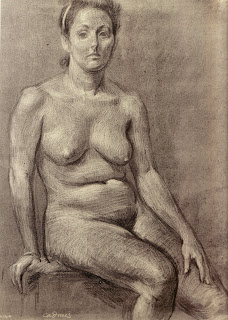
Paul Cadmus is now recognized as a progressive artist, who is well respected in drawing, painting and photography. His works are known for portraying compelling works of nude men.


Cadmus was born in New York, New York in 1904. Cadmus grew up in the city of New York and to a poor family. He knew that he wanted to become an artist at a young age, in part due to the positive influence of his parents, whom were both full time artists. At the age of fifteen Cadmus entered the National Academy of Design and continued and finished his studies at the Art Student League at the age of twenty-three. His schooling provided him with a strict classical education inclusive of drawing, printmaking, lithography and painting.


Cadmus was a very successful student, but found his classical education to be useful, but also repetitive and bland. He continued his artistic studies independently and through them met his friend, Jared French, who became his lover, inspiration and travel mate. The two saved money for nearly four years so that they could invest into traveling abroad and in order to learn and be exposed to the art in Europe. In 1931 the two ventured to France and Spain, and due to the Depression were able to live cheaply there until 1933. Cadmus gained the most inspiration from J. French, who urged Cadmus to create paintings from his mind rather than from existing figures and spaces. Cadmus and French left Europe in 1933 after Cadmus received press clippings from his sister about the Public Works Arts Project, which was being implemented as a part of the New Deal under President Roosevelt.

When Cadmus arrived to New York he applied for an opportunity to work with the government funded Public Works Art Project. He was speedily accepted into the program and soon after created his controversial painting, Fleet’s In!. The painting portrayed American sailors drinking, smoking, looking for play, relaxed and enjoying themselves. The work created a tremendous uproar with the public, the Navy, and the PWPA. People and members of the Navy felt that the painting mocked the image of the Navy by showing portraying them as intoxicated, hitting on both men and women, and demonstrating insulting reckless behavior. Of course, the strong response publicized Cadmus as an artist and gave his career a positive push forward. Today the original painting is in the Navy Historical Center.


Cadmus continued to paint a wide variety of subject matter. He tackled visions in his own mind, renderings of people in public places, racial lynching, massacres (journalistic art), and the idea of the classical nude. His nude drawings, which were produced later in his career, are, according to one source, 75% of his completed drawings. To Cadmus, drawing was similar to music, something a person had to practice daily, but also something he immensely enjoyed and took seriously. He says of his nude models that, “… [one should] try to have as close as a communion with [ones] model as possible under the circumstances. In other words, involve yourself. Don’t draw what you cannot get involved with.”

QUESTIONS:
How do the following quotations by Cadmus affect your interpretation of his work?

" Labels are swarming everywhere like nipping gnats. The advise people what to think so that they do not need to bother to think, feel or sense for themseles. An artist IS or IS NOT...Labels indicating gender, color of skin, sexual orientation are just a kind of gossip..."
Of his male nudes:
"I specialize in male nudes. I've done many more males than females. I like to do females too, but they are sort of harder to come by in a way. And they don't generally pose as well as men. They have a tendency to faint. I think-and I don't know whether it is just my own idea-that men are vainer than women in that they work harder at posing. Maybe women think they are so lovely that they don't have to pose well, I'm not sure. I don't know if you feelings are at all erotic towards the model whether or not that would make a better drawing or not. It might make it worse, I'm not sure. I suppose either way, the cooler you are maybe the better you draw. I've been drawing now Anderson for seventeen years now. I mark everything so that the models can get back to in the exact position, because, ideally, they should pose like apples or pears, except that they don't rot-at least not as quickly...


About Fleet's In!:
"I owe the start of my career really to the Admiral who tried to suppress it. I didn't feel an moral indignation about those sailors, even though it wouldn't be my idea of a good time. The girls are not particularly attractive, neither are the sailors as a matter of fact...But I always enjoyed watching them. I somewhat envied them the freedom of their lives and their lack of inhibitions. And I observed. I was always watching them. I didn't know them personally, I was not going after them or expecting any relationship with them, but they were fun to watch.

Of his work:

"I never aimed to be controversial. I suppose it was just my objection to society as it was. [All of the WPA projects] caused some controversy, as did other woks of mine done later."

On Coney Island:
"I did it for myself...Coney Island seemed to me a sort of classical American subject.


All of the male nude models are physically pleasing to they eye, why do you believe this to be so? Does it affect the meaning of the work? Does it say something about the artist? Is it simply mimicking the classical nudes in the past, which were also quintessentially portrayed? Does it mean anything at all?

How do the positions of the men in the paintings make you feel as a viewer? If the people were women how would you view the paintings? Compare and contrast the male and female nudes.

The men are often not looking at the viewer, does this make the paintings demeaning towards men?

Why does Cadmus portray nudes of people doing everyday things while naked?

How do his female nudes contrast to his male nudes?

In his paintings of people, what do the details/general scene in the work say about the environment, culture, about people, tradition, 'normal' etc...? What do they say to you as a viewer...are they social statements?

Are the Seven Deadly Sins portrayed as males or as females?

Coney Island
(mural)
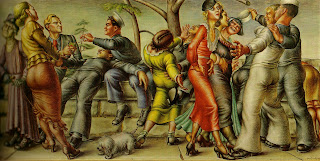


Fleet's In
(mural)
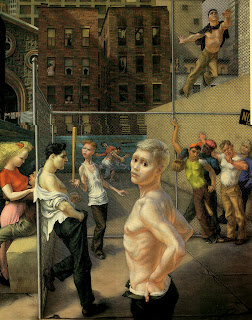


Playground
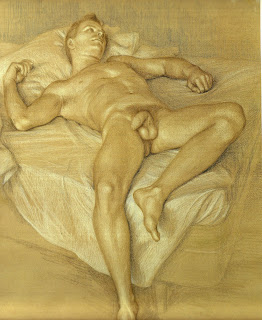


Male Nudes
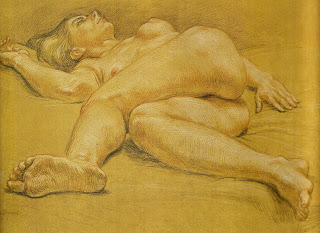


Female Nudes
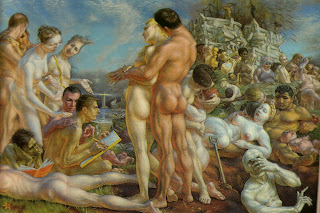


"What I Believe"


Seven Deadly Sins (4 of 7)